BANK OF ALBANIA
PRESS RELEASE
Second Deputy Governor Ahmetaj at the Economic Forum: “Strategic Connectivity and Regional Economic Growth: The Economic Potential of Corridor VIII”
Publication date: 18.02.2026
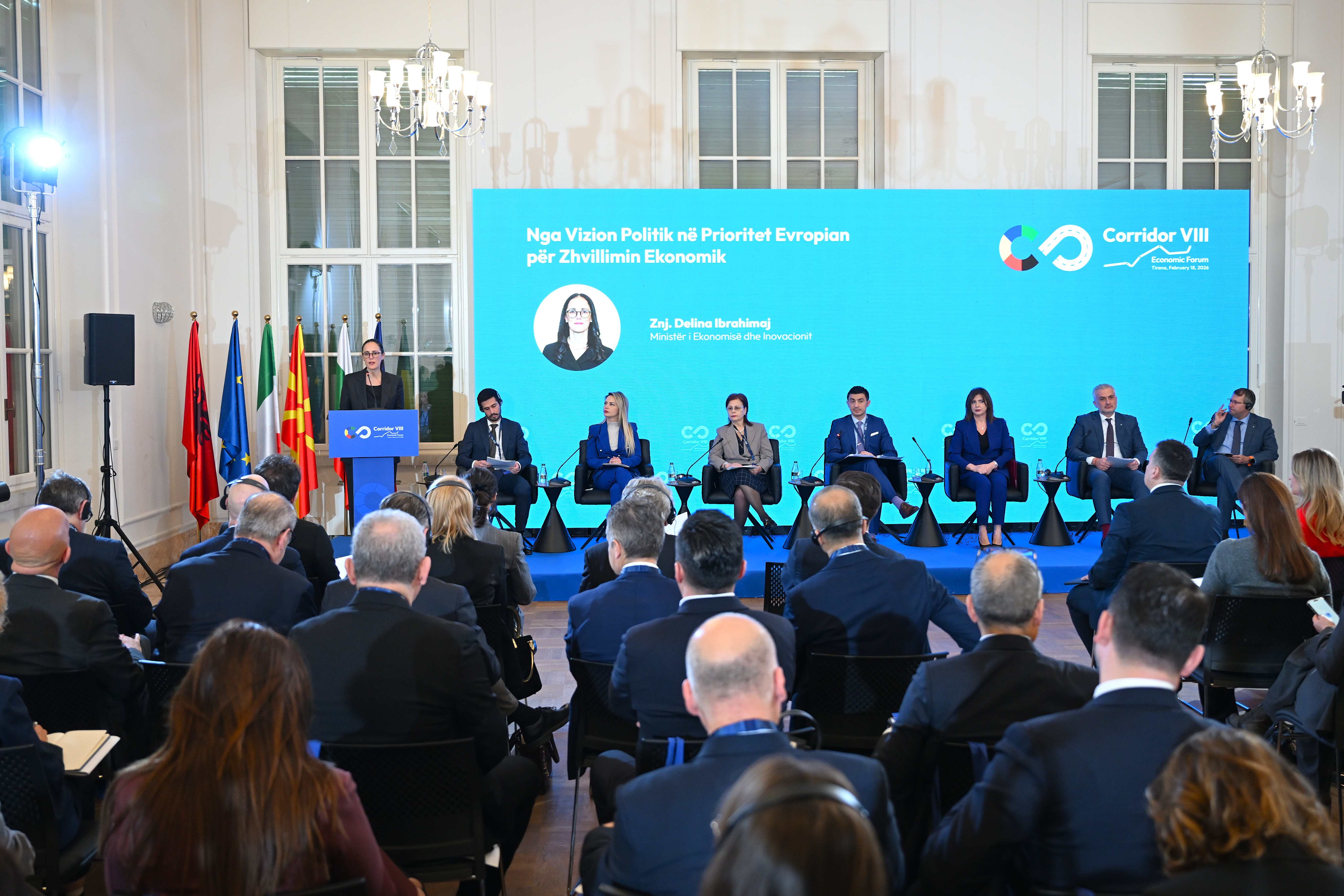
The Second Deputy Governor of the Bank of Albania, Ms. Natasha Ahmetaj, participated in the high-level Economic Forum on “Strategic Connectivity and Regional Economic Growth: The Economic Potential of Corridor VIII,” held today in Tirana. The Forum was convened within the framework of the Corridor VIII Ministerial and brought together official delegations from Albania, North Macedonia, Bulgaria, Italy, and Romania, alongside representatives of partner countries. The event reaffirmed the strategic significance of this infrastructural and geopolitical project for the region.
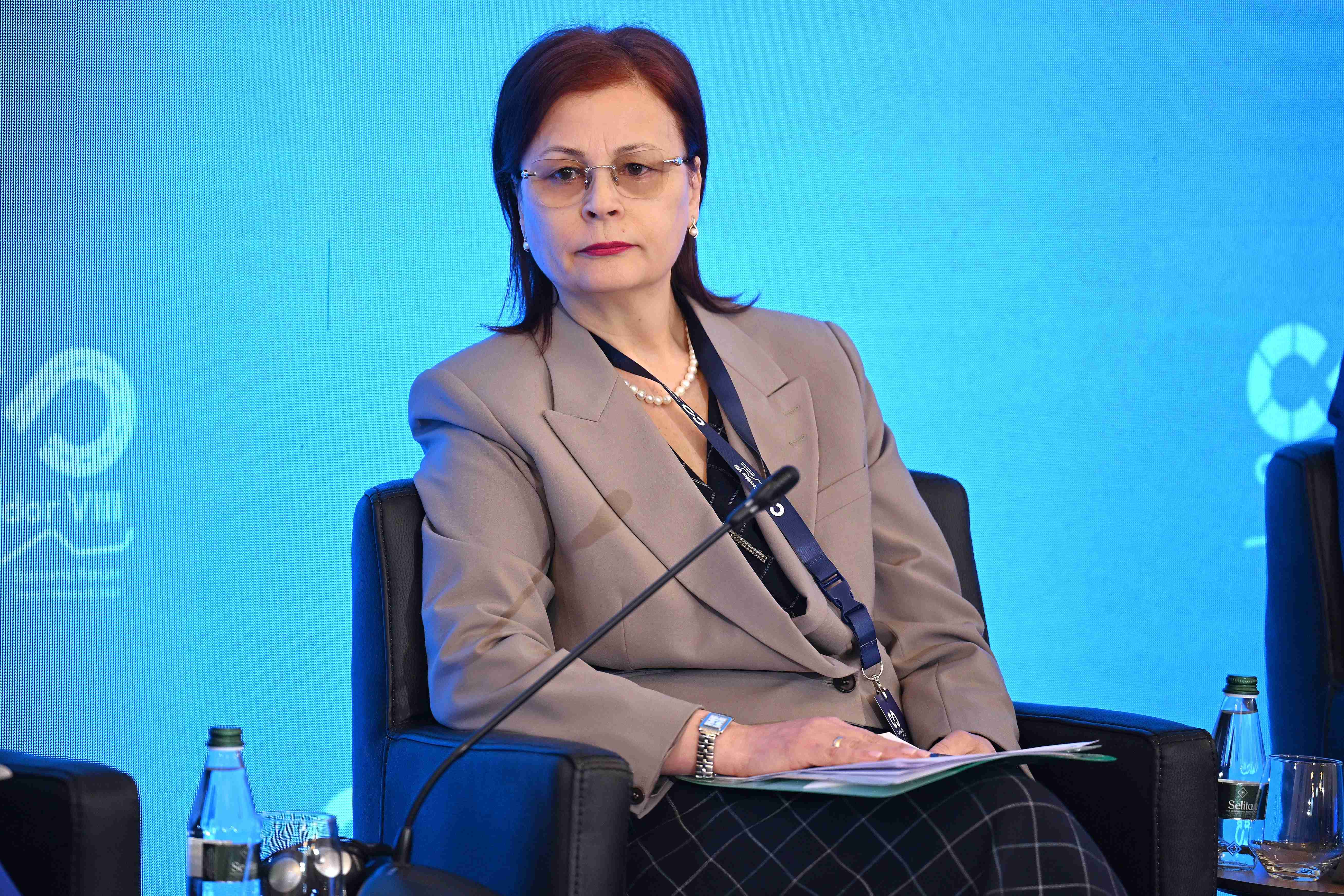
Ms. Ahmetaj contributed to the Forum’s first panel on “From Political Vision to a European Priority for Economic Development,” which outlined the political and strategic framework of the Forum, while addressing Corridor VIII as a pivotal instrument for advancing European integration, fostering sustainable economic development, and strengthening regional stability. The panel analysed Albania’s role as a key East–West hub and gateway to the Adriatic, underscoring the importance of Corridor VIII in supporting the implementation of the National Strategy for Development and Integration 2022–2030, the Economic and Investment Plan for the WB6, and the Berlin Process.
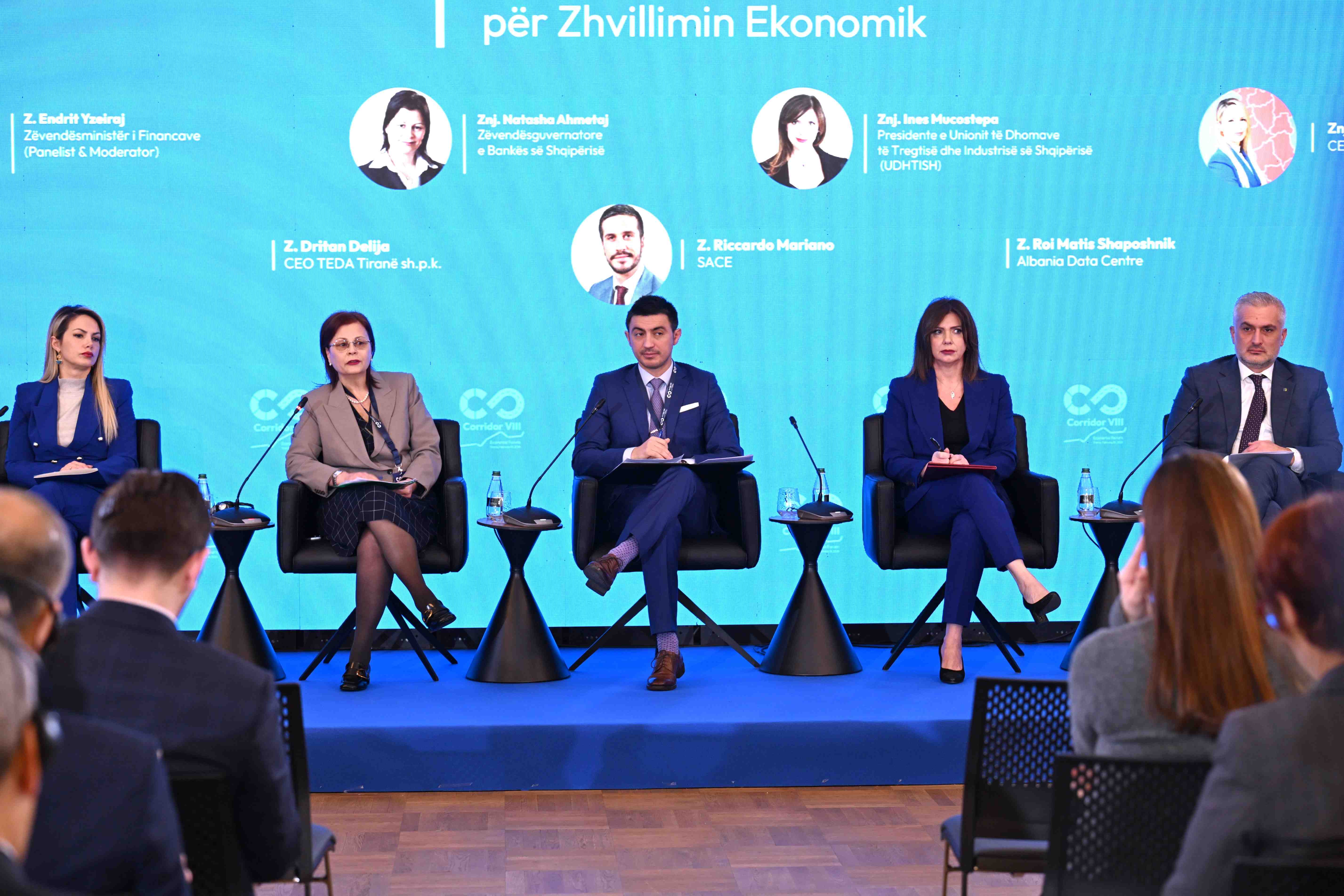
In her address, Second Deputy Governor Ahmetaj highlighted that monetary policy and financial stability are key elements in supporting economic growth, underlining that macroeconomic stability is a prerequisite for the implementation of major infrastructure projects.
Her focus was on Corridor VIII within the context of the European integration process, stressing that the European Union is founded on the four fundamental freedoms – the free movement of capital, goods, services, and people –while infrastructure corridors represent the physical manifestation of this free movement. Corridors-which in the past were seen merely as instruments to reduce transport costs-today serve as powerful tools for economic and institutional integration.
Ms Ahmetaj underlined that Corridor VIII is a historic opportunity for Albania, in reducing trade costs, enhancing export competitiveness, and strengthening the role of the Port of Durrës as a transit hub and regional logistics centre. The development of the corridor can serve as a catalyst for diversifying Albania’s economic structure, encouraging the growth of light industry, logistics, processing, and re-export activities.
Moreover, she noted that the development of the corridor can serve as a catalyst for diversifying the country’s economic structure, fostering the growth of light industry, logistics, processing, and re-export activities, while reinforcing Albania’s position within regional and European value chains.
Another important aspect, according to her, is its impact on employment, the reduction of regional disparities between coastal and eastern Albania, and the promotion of more balanced urbanization. She also pointed out the geopolitical importance of increasing economic connectivity, noting that stronger economic ties reinforce political and regional stability.
Focusing on the role of the financial sector, the Second Deputy Governor underlined that the Albanian banking system is well-capitalized, liquid, and built on European regulatory standards, with micro- and macroprudential safeguards that ensure resilience even in the face of potential shocks. Nevertheless, large infrastructure projects require cooperation with international partners and blended financing.
In her remarks, Ms Ahmetaj also addressed the continuous contribution of the Bank of Albania to the European integration process through the approximation of its regulatory and supervisory framework with European Union standards, the strengthening of macro- and microprudential mechanisms, and the modernization of payment infrastructure. The harmonization of financial legislation, the preparation of the banking system for deeper integration into the European financial market, and the advancement of processes such as inclusion in SEPA demonstrate the institution’s concrete commitment to supporting the country’s economic integration and ensuring financial stability in line with European standards. In this context, Ms Ahmetaj underlined the importance of integrating Albania’s financial system into the European payments area, stressing that participation in SEPA enables faster and lower-cost transactions with euro area countries, thereby supporting the growth of trade and financial exchanges along Corridor VIII.
 Linkedin
 X
X
 Facebook
 Instagram
 Flickr
 Albanian Money App
 RSS
RSS
 Subscribe
 Contact
 Feedback